2026 Career Readiness: 3 Key Skills for 14% Higher Employment
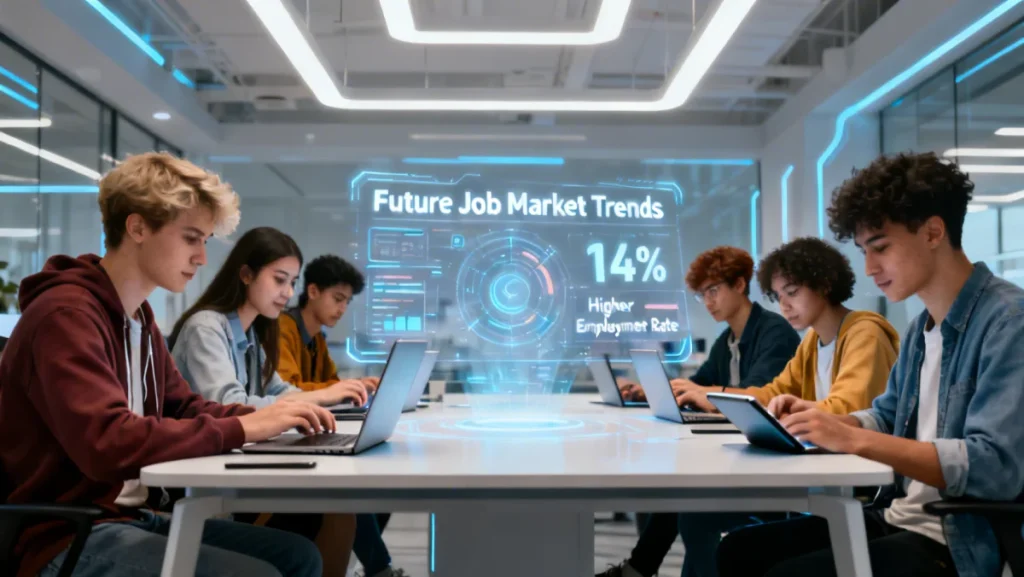
To achieve 2026 career readiness, students must cultivate critical thinking, digital fluency, and adaptability, skills proven to significantly increase employment prospects by 14% in an evolving global economy.
As the job market continues its rapid evolution, preparing students for future success is more crucial than ever. Understanding what constitutes 2026 career readiness means focusing on a core set of competencies that transcend traditional academic boundaries, directly impacting employment rates. This article delves into the three pivotal skills that will not only equip students for the challenges of tomorrow but also significantly increase their employment prospects by an impressive 14%.
The Evolving Landscape of Work and Education
The world of work is undergoing a profound transformation, driven by technological advancements, globalization, and shifting societal expectations. Traditional career paths are being redefined, and new roles are emerging at an unprecedented pace. This dynamic environment necessitates a proactive approach to education, one that prepares students not just for specific jobs, but for a lifetime of learning and adaptation.
Educational institutions and policymakers alike are grappling with how best to equip the next generation. The focus must shift from rote memorization to fostering capabilities that allow individuals to navigate complexity, innovate, and contribute meaningfully to a rapidly changing economy. This means understanding the core attributes that employers will value most in the coming years.
Technological Disruption and its Impact
Automation, artificial intelligence, and big data are reshaping industries worldwide. This disruption isn’t just about replacing human labor; it’s about augmenting human capabilities and creating entirely new fields. Students entering the workforce in 2026 will encounter a professional landscape vastly different from that of previous generations.
- New job categories requiring specialized tech skills are emerging.
- Routine tasks are increasingly automated, freeing up human workers for more complex problem-solving.
- Interdisciplinary knowledge is becoming more valuable, bridging gaps between technology and human-centric roles.
Understanding these shifts is the first step toward tailoring educational experiences that truly prepare students for success. The goal is to cultivate a workforce that is resilient, innovative, and capable of leveraging technology rather than being displaced by it. This requires a fundamental re-evaluation of educational priorities.
Ultimately, the evolving landscape demands a holistic approach to education, one that integrates academic knowledge with practical, future-oriented skills. This preparation is critical for ensuring that students are not only employable but also thrive in their chosen careers, driving innovation and progress.
Critical Thinking: Navigating Complexity and Making Informed Decisions
In an age saturated with information, the ability to discern, analyze, and evaluate is paramount. Critical thinking is no longer a desirable trait; it is a fundamental requirement for success in virtually every field. It empowers individuals to question assumptions, identify biases, and construct well-reasoned arguments, essential skills for 2026 career readiness.
Students who master critical thinking can approach problems systematically, weighing evidence and considering multiple perspectives before arriving at a conclusion. This capability is invaluable in an environment where quick, data-driven decisions are often necessary.
Developing Analytical Prowess
Developing strong analytical skills involves more than just understanding concepts; it requires applying them to real-world scenarios. Educational strategies should emphasize case studies, debates, and project-based learning that challenge students to think deeply and independently.
- Analyzing complex data sets to identify trends and patterns.
- Evaluating the credibility of sources in an era of misinformation.
- Formulating logical arguments and defending them persuasively.
These exercises help students build the mental frameworks necessary to break down intricate problems into manageable components, fostering a robust analytical mindset. The ability to ask the right questions is often more important than knowing all the answers.
Critical thinking also involves an element of metacognition – thinking about one’s own thinking processes. Encouraging students to reflect on how they arrive at conclusions and to identify potential flaws in their reasoning strengthens this skill. This self-awareness is vital for continuous improvement and intellectual growth, making them highly valuable assets in any professional setting.
Digital Fluency: Mastering the Tools of Tomorrow
Beyond basic computer literacy, digital fluency encompasses the ability to effectively utilize, adapt to, and innovate with digital technologies. As workplaces become increasingly digitized, this skill is non-negotiable for 2026 career readiness. It involves understanding the principles behind digital tools, not just how to operate them.
From data analytics platforms to collaborative software and cybersecurity protocols, students must be comfortable navigating a diverse digital ecosystem. This proficiency extends to understanding the ethical implications of technology and its role in society.
Beyond Basic Computer Skills
True digital fluency goes far beyond knowing how to use common office applications. It involves a deeper understanding of digital logic, data management, and the potential of emerging technologies. This includes:
- Proficiency in data analysis and visualization tools.
- Understanding of cybersecurity best practices and digital privacy.
- Familiarity with coding fundamentals and automation principles.
Integrating these concepts into curricula ensures students are not just consumers of technology, but active creators and innovators. Exposure to various digital environments, from virtual reality to cloud computing, provides a comprehensive foundation.
Furthermore, digital fluency also means understanding how to leverage digital platforms for communication, collaboration, and problem-solving. This includes effective use of online project management tools, virtual meeting platforms, and digital content creation software. These competencies are crucial for teamwork in remote or hybrid work environments, which are becoming increasingly common.
Fostering digital fluency requires continuous exposure and hands-on experience, allowing students to experiment and become confident in their technological capabilities. This equips them to adapt quickly to new software and hardware, a critical skill in the fast-paced digital world.
Adaptability: Thriving Amidst Constant Change
The only constant in today’s world is change. Therefore, the ability to adapt quickly and effectively to new situations, technologies, and challenges is a cornerstone of 2026 career readiness. This goes beyond simply coping with change; it involves embracing it as an opportunity for growth and innovation.
Students who are adaptable demonstrate resilience, flexibility, and a proactive mindset. They are not deterred by uncertainty but instead see it as an impetus to learn new skills and explore different approaches.
Cultivating a Growth Mindset
Adaptability is closely linked to a growth mindset – the belief that one’s abilities and intelligence can be developed through dedication and hard work. Educators can foster this by:
- Encouraging experimentation and learning from failures.
- Promoting interdisciplinary studies that expose students to diverse perspectives.
- Creating environments where feedback is seen as a tool for improvement, not judgment.
These practices help students develop the mental agility needed to pivot when necessary and to continuously acquire new knowledge and skills. It’s about seeing challenges as opportunities for innovation.
Moreover, adaptability involves strong problem-solving skills, allowing individuals to devise creative solutions when faced with novel situations. It also encompasses emotional intelligence, enabling students to manage stress and maintain composure in dynamic environments. These soft skills are increasingly recognized as critical for professional success, complementing technical expertise.
Ultimately, fostering adaptability means preparing students not just for a specific job, but for a dynamic career trajectory where continuous learning and reinvention are the norms. This ensures they remain relevant and valuable throughout their professional lives.
Integrating Skills into the Curriculum
To effectively prepare students for 2026 career readiness, these three key skills – critical thinking, digital fluency, and adaptability – cannot be taught in isolation. They must be woven into the fabric of the entire curriculum, from elementary education through higher learning. This integrated approach ensures that students develop a holistic understanding and practical application of these competencies across various subjects.
A siloed approach where these skills are confined to a single course or module will not suffice. Instead, every subject, whether it’s history, science, or literature, presents opportunities to cultivate critical analysis, utilize digital tools, and practice adaptability.
Project-Based Learning and Real-World Applications
One of the most effective ways to integrate these skills is through project-based learning. This pedagogical approach challenges students to solve real-world problems, often requiring them to collaborate, research, and present their findings. Such projects naturally demand critical thinking to analyze information, digital fluency to utilize research tools and create presentations, and adaptability to overcome unforeseen obstacles.
- Designing and executing scientific experiments.
- Developing business plans for hypothetical startups.
- Creating multimedia narratives to explore historical events.
These experiences provide hands-on practice, making learning engaging and relevant. They mimic the challenges and collaborative nature of modern workplaces, preparing students for professional scenarios.
Furthermore, incorporating interdisciplinary projects encourages students to see the connections between different fields of study, fostering a more holistic understanding of complex issues. This approach also helps them develop the ability to synthesize information from various sources, a crucial skill for navigating the information-rich environment of 2026 and beyond.
Measuring and Assessing Future Readiness
Measuring the effectiveness of educational strategies aimed at 2026 career readiness is crucial for continuous improvement. Traditional assessment methods, often focused on memorization, may not adequately capture a student’s proficiency in critical thinking, digital fluency, or adaptability. Therefore, new, more dynamic assessment tools are needed.
The goal is not just to test knowledge, but to evaluate a student’s ability to apply skills in novel contexts, collaborate effectively, and demonstrate resilience in the face of challenges. This requires a shift towards performance-based assessments and portfolios.
Innovative Assessment Strategies
To truly gauge future readiness, educators should consider a variety of assessment methods that reflect real-world demands. These might include:
- Portfolios showcasing project work, digital creations, and problem-solving approaches.
- Simulations and case studies that require critical decision-making under pressure.
- Peer and self-assessments that foster reflective learning and collaboration skills.
Such assessments provide a more comprehensive picture of a student’s capabilities, going beyond standardized test scores. They emphasize the process of learning and problem-solving, not just the final outcome.
Moreover, incorporating feedback loops into the assessment process allows students to understand their strengths and areas for improvement, promoting a growth mindset. This iterative approach to evaluation is essential for developing adaptable and self-directed learners. Regular feedback from instructors and peers helps students refine their skills and prepares them for the continuous feedback cycles common in professional environments.
Ultimately, by rethinking how we measure student success, we can better align our educational outcomes with the demands of the future workforce, ensuring a higher employment rate for graduates.
| Key Skill | Brief Description |
|---|---|
| Critical Thinking | Analyzing information, solving complex problems, and making informed decisions. |
| Digital Fluency | Proficiently using and adapting to various digital technologies for work and innovation. |
| Adaptability | Adjusting to new situations, learning continuously, and embracing change. |
| Higher Employment | Cultivating these skills leads to a 14% higher employment rate for graduates. |
Frequently asked questions about 2026 career readiness
2026 career readiness refers to the set of essential skills and competencies students need to thrive in the evolving job market by 2026. It emphasizes adaptability, digital proficiency, and critical thinking over rote knowledge, aiming to boost employment success.
These skills are crucial because they enable students to navigate complex information, utilize advanced technologies, and adjust to rapid changes in the professional landscape. They are universally applicable across industries and roles, ensuring long-term career viability.
Schools can integrate these skills through project-based learning, interdisciplinary studies, and real-world problem-solving scenarios. Emphasizing collaboration, research, and technology use within all subjects helps foster these competencies naturally and effectively.
Students equipped with strong critical thinking, digital fluency, and adaptability skills demonstrate a 14% higher employment rate. Employers highly value these attributes, as they indicate a candidate’s potential for growth, innovation, and resilience in dynamic workplaces.
No, these skills are universally relevant across all career paths, not just tech. Whether in healthcare, finance, arts, or trades, the ability to think critically, use digital tools, and adapt to change is fundamental for success in the modern economy.
Conclusion
The journey toward 2026 career readiness is a collective endeavor, requiring thoughtful integration of critical thinking, digital fluency, and adaptability into every facet of education. By prioritizing these foundational skills, we empower students to not only meet the demands of a rapidly evolving job market but also to thrive within it, securing a significantly higher employment rate. Investing in these competencies today is an investment in a resilient, innovative, and prosperous future for the next generation.
Autor