Student Loan Forgiveness 2026: 3 Key Pathways to Debt Relief
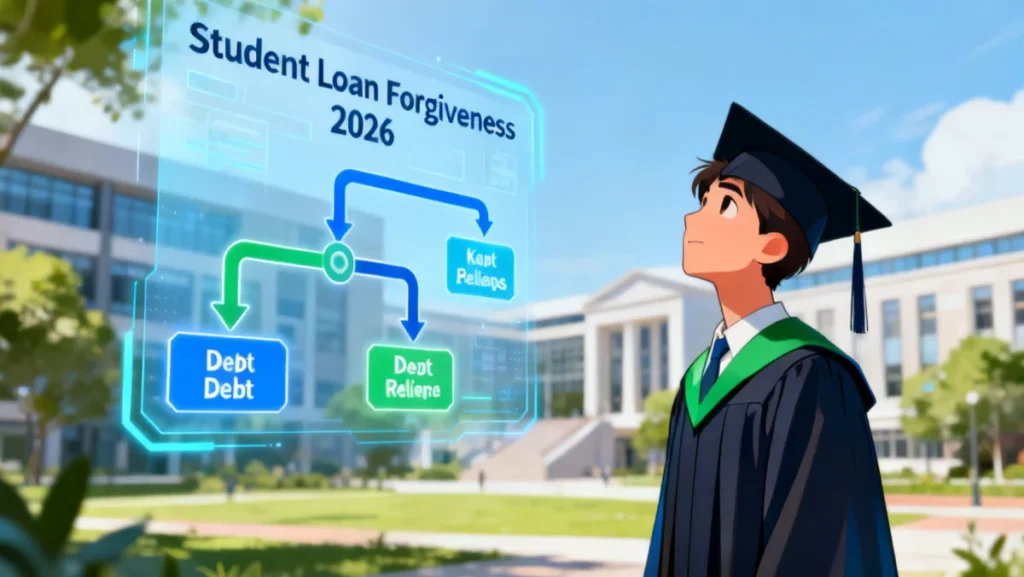
Understanding student loan forgiveness 2026 involves navigating the three primary federal pathways designed to offer borrowers debt relief after 10 years of qualifying payments, primarily through income-driven repayment plans, public service, or teacher programs.
For millions of Americans, the burden of student loan debt is a significant financial challenge, shaping life decisions and future planning. As we look towards 2026, understanding the mechanisms for student loan forgiveness 2026 becomes critically important. The federal government continues to offer several avenues for borrowers to achieve debt relief, particularly after a decade of consistent payments. This article will delve into the three key pathways designed to help you navigate your way to financial freedom from student loans, providing a comprehensive overview of each program’s requirements, benefits, and how to maximize your chances of approval.
Understanding the Landscape of Student Loan Forgiveness in 2026
The student loan landscape is constantly evolving, with policy changes and updates impacting how borrowers can achieve forgiveness. In 2026, the core principles of federal student loan forgiveness remain centered around specific programs that reward consistent payment and public service. It’s not a one-size-fits-all solution; rather, it requires borrowers to actively engage with their loan servicers and understand the nuances of each available pathway. The goal is to provide a clear roadmap for those seeking to alleviate their student debt.
Many borrowers often feel overwhelmed by the sheer volume of information surrounding student loans. However, breaking down the options into manageable categories can simplify the process. The main federal programs are established to support different career paths and financial situations, ensuring that a broad spectrum of borrowers can potentially benefit. Staying informed about these programs and any legislative changes is crucial for successful debt relief.
The Importance of Federal Student Loans
Federal student loans are the cornerstone of these forgiveness programs. Unlike private loans, federal loans come with a host of borrower protections and repayment options, including access to income-driven repayment (IDR) plans and various forgiveness initiatives. Understanding whether your loans are federal or private is the first critical step in exploring forgiveness options.
- Direct Loans: The most common type of federal student loan, eligible for most forgiveness programs.
- FFEL Program Loans: Some older FFEL loans may require consolidation into a Direct Consolidation Loan to become eligible.
- Perkins Loans: Certain Perkins Loan borrowers may qualify for specific cancellation programs, often tied to teaching or public service.
The distinction between federal and private loans cannot be overstated. Private loans generally do not offer the same forgiveness benefits, making it essential for borrowers to confirm the type of loans they hold. This initial assessment will guide you toward the appropriate forgiveness pathways and prevent wasted effort.
In conclusion, the 2026 student loan forgiveness landscape, while complex, offers tangible relief through federal programs. A clear understanding of your loan types and the available pathways is the foundation for navigating towards debt relief. Being proactive and informed will significantly enhance your chances of success.
Pathway 1: Income-Driven Repayment (IDR) Plan Forgiveness
One of the most widely accessible pathways to student loan forgiveness 2026 is through Income-Driven Repayment (IDR) plans. These plans are designed to make monthly loan payments more affordable by capping them at a percentage of your discretionary income. After a specified period, typically 20 or 25 years (or 10 years for certain professions under PSLF, which we’ll cover next), any remaining balance on your federal student loans is forgiven.
The principle behind IDR plans is to ensure that borrowers are not unduly burdened by their student loan payments, especially if their income is low relative to their debt. By aligning payments with financial capacity, these plans offer a safety net and a long-term strategy for debt elimination. This pathway is particularly beneficial for those with high loan balances and moderate incomes.
The Different IDR Plans
There are several types of IDR plans, each with slightly different terms and eligibility requirements. Understanding the nuances of each can help you choose the best plan for your financial situation:
- REPAYE (Revised Pay As You Earn): Generally offers the lowest monthly payments, capped at 10% of discretionary income. Forgiveness after 20 years for undergraduate loans, 25 for graduate.
- PAYE (Pay As You Earn): Also 10% of discretionary income, but payments never exceed the 10-year Standard Repayment Plan amount. Forgiveness after 20 years.
- IBR (Income-Based Repayment): Payments are 10% or 15% of discretionary income, depending on when you took out your loans. Forgiveness after 20 or 25 years.
- ICR (Income-Contingent Repayment): Payments are the lesser of 20% of discretionary income or what you’d pay on a fixed 12-year plan. Forgiveness after 25 years.
It’s crucial to recertify your income and family size annually to ensure your payments accurately reflect your financial situation. Failing to recertify can lead to higher payments and even capitalization of interest, which adds to your principal balance.

The forgiveness under IDR plans is generally taxable as income, unlike Public Service Loan Forgiveness (PSLF). This is an important consideration for borrowers approaching the end of their repayment period, as they should plan for potential tax liabilities. Consulting with a tax professional is highly recommended to understand the implications.
In summary, IDR plans offer a viable path to forgiveness for many federal student loan borrowers, making payments manageable and eventually eliminating debt. Careful selection of the appropriate plan and diligent annual recertification are key to successfully utilizing this pathway.
Pathway 2: Public Service Loan Forgiveness (PSLF)
For those dedicated to careers in public service, the Public Service Loan Forgiveness (PSLF) program represents a powerful and often quicker path to student loan forgiveness 2026. This program forgives the remaining balance on Direct Loans after you have made 120 qualifying monthly payments while working full-time for a qualifying employer. This means debt relief can be achieved in as little as 10 years.
PSLF was established to encourage individuals to enter and remain in public service roles, addressing critical needs in communities across the country. It is a highly sought-after program due to its relatively shorter timeline for forgiveness and the fact that the forgiven amount is not considered taxable income by the IRS.
Qualifying Employment and Payments
To qualify for PSLF, both your employment and your payments must meet specific criteria. Understanding these requirements is paramount for successful application:
- Qualifying Employer: This includes government organizations at any level (federal, state, local, tribal), and not-for-profit organizations that are tax-exempt under Section 501(c)(3) of the Internal Revenue Code. Some other non-profits that provide specific public services may also qualify.
- Full-Time Employment: Generally means working at least 30 hours per week for one or more qualifying employers.
- Qualifying Payments: Payments must be made on time, for the full amount due, under a qualifying repayment plan (typically an IDR plan), and after October 1, 2007.
It is highly recommended that borrowers submit an Employment Certification Form (ECF) annually, or whenever they change employers. This proactive step helps track your progress towards the 120 qualifying payments and ensures your employment is correctly categorized as qualifying by the Department of Education.
Borrowers must have Direct Loans to be eligible for PSLF. If you have FFEL Program loans or Perkins Loans, you will need to consolidate them into a Direct Consolidation Loan to become eligible. Payments made before consolidation do not count towards the 120 payments for PSLF, so it’s best to consolidate early in your public service career.
The PSLF program offers a significant incentive for individuals to pursue careers that benefit society. Its clear path to forgiveness after 10 years, coupled with the tax-exempt status of the forgiven amount, makes it an incredibly valuable option for eligible public servants. Consistent tracking of employment and payments is the key to maximizing its benefits.
Pathway 3: Teacher Loan Forgiveness and Other Specific Programs
Beyond IDR plans and PSLF, specific federal programs offer pathways to student loan forgiveness 2026 for individuals in particular professions or circumstances. The Teacher Loan Forgiveness (TLF) program is a prominent example, designed to encourage talented individuals to teach in low-income schools or educational service agencies.
These specialized programs often have more targeted eligibility criteria but can provide substantial relief for those who qualify. They represent the federal government’s effort to address shortages in critical sectors and support specific demographic groups, offering an alternative or supplementary route to debt eradication.
Teacher Loan Forgiveness (TLF)
The TLF program allows eligible teachers to receive up to $17,500 in forgiveness on their Direct Subsidized and Unsubsidized Loans and their Subsidized and Unsubsidized Federal Stafford Loans. To qualify, you must:
- Teach full-time for five complete and consecutive academic years.
- Work in a low-income elementary or secondary school or educational service agency.
- Have at least one loan disbursed after October 1, 1998.
The amount of forgiveness depends on the subject taught. Highly qualified math and science teachers at the secondary level, and special education teachers at either the elementary or secondary level, can receive up to $17,500. Other eligible teachers can receive up to $5,000.
Other Specialized Forgiveness Options
While less common, other programs exist for specific professions:
- Perkins Loan Cancellation: Teachers, nurses, law enforcement officers, and other public service professionals may qualify for cancellation of up to 100% of their Perkins Loans.
- Nurse Corps Loan Repayment Program: For registered nurses and nursing faculty working in critical shortage facilities, offering up to 85% of unpaid nursing education debt.
- National Health Service Corps (NHSC) Loan Repayment Program: For health professionals working in underserved communities, providing significant loan repayment in exchange for service.
- Total and Permanent Disability (TPD) Discharge: For borrowers who are unable to work due to a total and permanent disability.
- Borrower Defense to Repayment: For borrowers whose schools engaged in misconduct or fraud.
Each of these programs has its own set of rules and application processes. It is vital for borrowers to research and understand if they meet the specific requirements for any of these specialized forgiveness options. These programs, though niche, offer crucial support to professionals serving in high-need areas.
In conclusion, beyond the broader IDR and PSLF programs, there are targeted forgiveness initiatives for teachers and other professionals. These programs provide valuable debt relief and incentivize careers that benefit specific communities and sectors, highlighting the diverse approaches to student loan forgiveness available in 2026.
Navigating Eligibility and Application Processes
Understanding the pathways to student loan forgiveness 2026 is only half the battle; successfully navigating the eligibility criteria and application processes is equally critical. Each program has distinct requirements, and a misstep can delay or even disqualify you from receiving forgiveness. Proactive engagement with your loan servicer and meticulous record-keeping are essential.
The federal government has streamlined some of these processes over time, but the responsibility ultimately falls on the borrower to ensure all conditions are met. This section will outline general best practices for approaching any forgiveness application, emphasizing the importance of accuracy and persistence.
Essential Steps for Application
Regardless of the specific forgiveness program you pursue, several common steps and considerations apply:
- Confirm Loan Type: Verify that your loans are federal and eligible for the program you are targeting. Consolidation may be necessary for some older federal loans.
- Understand Program Requirements: Thoroughly review the specific eligibility criteria for your chosen pathway, including employment, payment history, and enrollment in certain repayment plans.
- Maintain Accurate Records: Keep detailed records of your employment, payment history, and any correspondence with your loan servicer. This is crucial for verifying your eligibility.
- Submit Required Forms: Complete and submit all necessary application and certification forms accurately and on time. For PSLF, this includes the Employment Certification Form.
- Monitor Your Progress: Regularly check your loan status and progress toward forgiveness with your loan servicer. Address any discrepancies promptly.
It is important to remember that the application process can sometimes be lengthy, requiring patience and diligence. Don’t be discouraged by initial hurdles; seek clarification from your loan servicer or the Department of Education if you encounter issues.
For IDR plans, ensuring annual recertification of your income and family size is non-negotiable. Failure to do so can result in your payments reverting to the higher standard plan amount, and any unpaid interest may capitalize, increasing your loan balance. This simple administrative task is vital for maintaining your eligibility for eventual forgiveness.
In essence, successful navigation of forgiveness programs requires a combination of informed decision-making, meticulous record-keeping, and proactive communication. By taking these steps, borrowers can significantly improve their chances of achieving student loan forgiveness in 2026 and beyond.
Potential Changes and Future Outlook for 2026
While the current pathways to student loan forgiveness 2026 are well-defined, the landscape of federal student aid is always subject to potential changes. Legislative actions, executive orders, and regulatory adjustments can all impact the availability and terms of forgiveness programs. Staying informed about these potential shifts is crucial for borrowers planning their debt relief strategies.
The political climate and economic conditions often influence discussions around student loan policy. As 2026 approaches, it’s wise to consider how these external factors might shape the future of forgiveness. While major overhauls are not always predictable, understanding the ongoing dialogue can help borrowers anticipate and adapt to any new developments.
Monitoring Policy Developments
Keeping an eye on official government announcements and reputable financial news sources is the best way to stay updated. Key areas to watch include:
- Legislative Proposals: New bills introduced in Congress could propose changes to existing forgiveness programs or introduce new ones.
- Department of Education Guidance: The Department of Education frequently issues guidance and updates on program administration, eligibility, and application processes.
- Economic Conditions: Broader economic trends can sometimes spur policy responses related to student debt relief.
Historically, there have been instances of temporary waivers or expansions of existing programs, such as the PSLF Limited Waiver, which provided a retrospective opportunity for many borrowers to count previously ineligible payments. While such broad waivers are not guaranteed for the future, they illustrate the potential for policy adjustments that can significantly benefit borrowers.
It is also important to differentiate between broad-based forgiveness initiatives, which may or may not materialize, and the established, statutory programs discussed in this article. Relying on existing programs with clear eligibility criteria provides a more concrete strategy for debt relief, while also remaining open to any new opportunities that may arise.
In conclusion, while the three key pathways to student loan forgiveness in 2026 offer robust options, awareness of potential policy changes is vital. Borrowers should remain diligent in monitoring official channels for updates, ensuring their debt relief strategies are aligned with the most current federal guidelines and opportunities.
Maximizing Your Chances for Forgiveness
Achieving student loan forgiveness 2026 requires more than just knowing the available programs; it demands a proactive and strategic approach. Maximizing your chances involves careful planning, consistent action, and a commitment to understanding the fine print of each program. It’s about being an engaged borrower who takes ownership of their financial future.
Many borrowers miss out on forgiveness opportunities simply because they aren’t fully aware of the requirements or fail to maintain the necessary documentation. This section provides actionable advice to help you optimize your journey toward debt relief, ensuring you are well-prepared for any application process.
Strategic Tips for Success
Consider these practical steps to enhance your likelihood of receiving forgiveness:
- Consolidate Early (If Necessary): If you have older federal loans (like FFEL or Perkins), consolidate them into a Direct Consolidation Loan as early as possible to make them eligible for PSLF and many IDR plans.
- Enroll in the Right IDR Plan: Choose an IDR plan that aligns with your income, family size, and career goals. For PSLF, any IDR plan will qualify, but REPAYE often provides the lowest payments.
- Automate Payments: Set up automatic payments to ensure you never miss a due date. On-time payments are a non-negotiable requirement for all forgiveness programs.
- Annual Review: Annually review your loan details, payment history, and program eligibility with your loan servicer. This helps catch errors and confirm you’re on track.
- Seek Professional Advice: If your situation is complex, consider consulting with a non-profit student loan counselor or a financial advisor specializing in student debt.
Another crucial aspect is understanding the tax implications of forgiveness. While PSLF is tax-free, forgiveness under IDR plans currently remains taxable income. Planning for this potential tax burden is a significant part of maximizing your overall financial benefit from forgiveness. Saving for this possibility or discussing it with a tax professional can prevent future surprises.
Furthermore, staying persistent is key. The process can sometimes be bureaucratic, and you might need to follow up multiple times with your loan servicer or the Department of Education. Don’t give up if you encounter challenges; advocate for yourself and ensure your application is processed correctly.
In conclusion, maximizing your chances for student loan forgiveness in 2026 involves a combination of informed choices, diligent record-keeping, and proactive engagement. By following these strategic tips, borrowers can navigate the complexities of federal programs more effectively and move closer to achieving significant debt relief.
| Key Pathway | Brief Description |
|---|---|
| Income-Driven Repayment (IDR) | Forgiveness after 20-25 years of payments based on income, typically taxable. |
| Public Service Loan Forgiveness (PSLF) | Forgiveness after 10 years (120 payments) for full-time public service, tax-free. |
| Teacher Loan Forgiveness (TLF) | Up to $17,500 for teachers in low-income schools after 5 consecutive years. |
Frequently Asked Questions About Student Loan Forgiveness 2026
Generally, only federal student loans are eligible for the forgiveness programs discussed. This includes Direct Subsidized, Unsubsidized, PLUS, and Consolidation Loans. Private student loans typically do not qualify for federal forgiveness programs, requiring different debt management strategies.
No, forgiveness is not automatic. You must actively apply for forgiveness once you meet the specific requirements of your chosen program. This often involves submitting an application to your loan servicer or the Department of Education, along with necessary documentation.
It depends on the program. Public Service Loan Forgiveness (PSLF) is tax-free. However, forgiveness under Income-Driven Repayment (IDR) plans is currently considered taxable income by the IRS. It’s crucial to consult a tax professional for personalized advice.
While you can pursue multiple eligibility paths, you can only ultimately receive forgiveness through one program for the same loan balance. For example, if you qualify for both PSLF and IDR forgiveness, you would choose the one that benefits you most, usually PSLF due to its tax-free status.
Missing a payment can negatively impact your progress toward forgiveness. For programs like PSLF, all 120 payments must be qualifying and on-time. Missing payments can reset your count or delay your eligibility. Always contact your loan servicer immediately if you anticipate payment difficulties.
Conclusion
The journey to student loan forgiveness 2026 offers tangible hope for millions of Americans burdened by educational debt. By understanding and strategically utilizing the three key pathways—Income-Driven Repayment (IDR) plan forgiveness, Public Service Loan Forgiveness (PSLF), and specialized programs like Teacher Loan Forgiveness—borrowers can chart a clear course toward debt relief. While each path has its unique requirements and considerations, consistent engagement, meticulous record-keeping, and proactive communication with loan servicers are universal keys to success. As the landscape of student aid continues to evolve, staying informed about potential policy changes will further empower borrowers to make the best decisions for their financial future, ultimately leading to significant and lasting debt freedom.
Autor